
Kayaking at Kabeyun
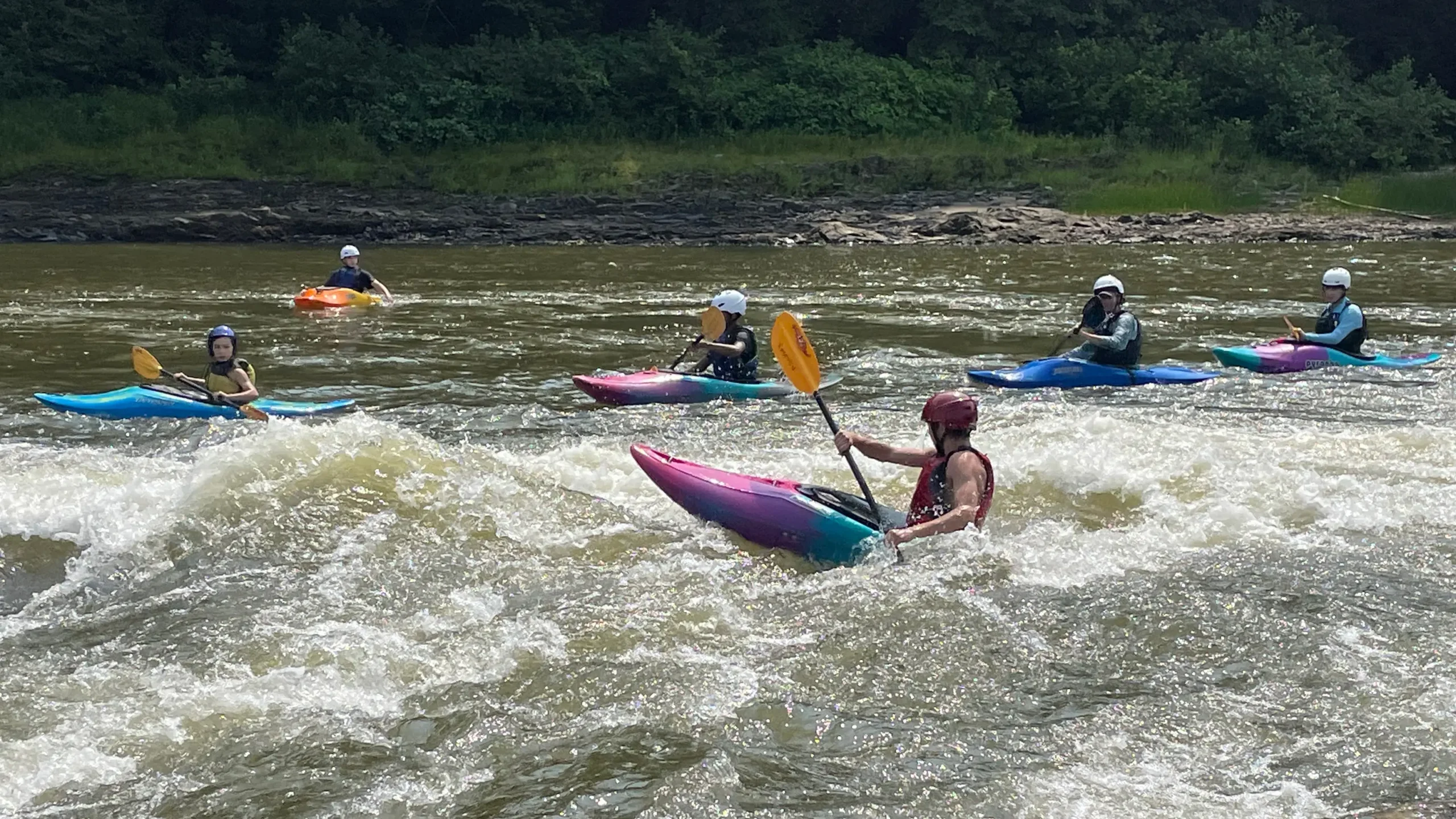
For campers, whitewater kayaking begins without any whitewater at all, in the sheltered Small Cove. It’s where we start small, learning to keep our boat straight and trying our first rolls, where the foundation is built for everything to come.
Kayaking as an activity at Kabeyun began much the same way. While canoes have been here since the earliest days, the first whitewater kayaks arrived around 1970 as build-it-yourself kits for long, fiberglass crafts. Camp hired several competition slalomists to demonstrate the new boats’ construction and basic handling, and those present recall a curious crowd forming by the shoreline, intrigued by the peculiar closed-cockpit design and skeptical of the apparent tippiness. Whitewater kayaking as a whole was still in its infancy at the time—it was as much a zealot’s shop project as a watersport—and Kabeyun was the rare summer camp to incorporate it.
At first, campers and counselors learned alongside each other, practicing wet exits and testing out strokes in the calm Winnipesaukee water. Before long, a kayak or two earned a spot on the canoe racks bound for the Androscoggin. Kabeyun once again rode the early waves of kayak development when, in the mid-1970s, director Nick Latham purchased six of some of the first plastic kayaks, Hollowform River Chasers, which could better handle the bumps and scrapes of real whitewater. As interest and confidence rose through the 1970s, kayaking became an activity of its own, borrowing its numeric rating system from canoeing.
During the first half of the 1980s, Kabeyun added more user-friendly boats to its fleet: several nimble, cutting-edge Perception Mirages and then, once Nick could be convinced that camp’s older boats were too beat up for yet another round of repairs, a dozen shorter, more playful Perception Dancers. Around the same time, the activity’s focus shifted from simply running a rapid top-to-bottom to a more technical approach. At the forefront was Terry Dash, who arrived in the mid-’80s and emphasized skills like catching eddies and basic playboating, and dramatically expanded the program’s repertoire of rivers.
Kayaking’s rating system developed alongside the instruction. Whereas the K4 had previously been awarded as soon as a camper could do a flatwater roll, it has come to demand precise river-running skills and leadership abilities on challenging whitewater. The rating is the result of many summers of practice after getting one’s first bite from the kayaking bug in the cradle of the Small Cove, finding magic at the tips of their paddleblades.
Jesse Metzger is a stalwart of Kabeyun’s paddling staff. He first learned to kayak as a Kabeyun camper, and has paddled for his own enjoyment and as an instructor across the US and abroad. In 2023, Kabeyun pruchased a dozen new kayaks, called the Dagger Rewind, in three sizes to fit campers of all ages. You can read more about those boats and what they bring to Kabeyun’s programming here.
This article is excerpted from “Kabeyun: The First 100 Years,” a beautiful book published as part of camp’s centennial celebration. It’s available for purchase here.